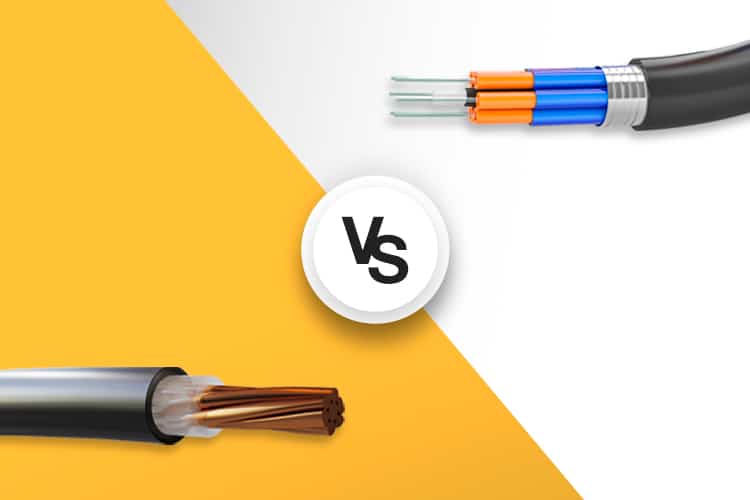
First, it is important to point out that fiber optics and copper are hardly comparable, as each has its own advantages and disadvantages. However, if we were to highlight a difference in terms of cost, we find that copper links and connections are more economical than fiber optic ones. Nevertheless, when considering performance, fiber is far more cost-effective than copper.
Additionally, the growing demand for bandwidth in today’s required applications gives a clear edge to fiber optic cable over copper cable, especially considering its long-term viability, which establishes fiber optics as the best bet for the future of short- and long-distance telecommunications.
Below, we present 5 reasons why fiber optic cabling is the best choice over copper cabling: bandwidth, distance and transmission speed, reliability, security, and, of course, cost.
BANDWIDTH
Although copper is perfectly adequate for a voice signal, it has a very limited bandwidth. In contrast, fiber is capable of providing a standardized performance of over 10 Gbps. This means that fiber links offer 1,000 times more bandwidth than copper over distances 100 times greater.
For example, a standard bandwidth-distance application for multimode fiber is 500 MHz/km, meaning a 500 m cable can transmit 1 GHz. Conversely, a twisted pair copper cable optimized for high data rates (Cat 6) can transmit 500 MHz over just 100 m. Furthermore, copper experiences higher signal loss (attenuation) at high frequencies, which is negligible over 500 m of fiber.
DISTANCE AND SPEED
Fiber optics transmit light, while copper transmits electrical current. The speed of photons versus the speed of electrons bears no comparison. Electrons in copper travel at less than 1% of the speed of light, and although fiber optic cables do not reach the speed of light (due to the medium’s refractive index), they are only about 30% slower. This demonstrates the enormous inherent speed gap between fiber and copper.
Moreover, while twisted pair copper has a distance limitation of 100 m, fiber has no such restriction. As a result, distances can range from 550 m for 10 Gbps multimode up to 40 km on a single-mode fiber optic cable.
RELIABILITY
Fiber optic cable is far less susceptible to environmental factors than copper. For instance, copper experiences degraded transmission quality over a 2 km stretch, whereas over the same distance, a fiber optic cable maintains highly reliable transmission. Additionally, fiber is less sensitive to environmental factors such as temperature and electromagnetic interference, allowing fiber cable to be deployed in industrial environments with high electrical noise without hesitation. In some cases, optical fibers are even built into medium- and high-voltage power lines in overhead deployments or in intercontinental submarine cables.
SECURITY
Fiber optics are completely dielectric, meaning they do not transmit electricity or emit radiation that could harm people or equipment. On the other hand, copper can be susceptible to wiretapping, which can cause the entire system to fail. A broken or damaged optical fiber can be detected extremely fast using the necessary diagnostic equipment, including real-time transmission health certification. Meanwhile, a copper cable carrying current can be completely cut or even present a fire hazard if it is degraded, old, or used without proper testing procedures.
COST
While it is true that the price of fiber optic cable used to be almost double that of copper, the gap has narrowed significantly, and the cost of fiber components and everything related to their handling and installation has decreased over time.
In general, transmitting electrical energy over copper is more economical than transmitting laser energy through fiber, but this is changing due to the high demand for bandwidth in today’s applications. Most users overlook the comprehensive cost of all the elements required for a proper copper cabling deployment, which should not be ignored. Let’s not forget that a standard cabling cabinet includes energy costs for UPS (Uninterruptible Power Supply), data room floor space, HVAC (Hybrid Automatic Voltage Control/environmental cooling), and the physical space occupied by the large volume of cabling required in raised floors and drop ceilings.
These comprehensive costs generally exceed the additional cost of fiber equipment in a centralized fiber architecture, while also taking up far more workspace than fiber. Therefore, a fiber LAN (Local Area Network) is actually more economical and space-efficient than a copper-based network environment for new construction and major renovations.
CONCLUSIONS
The arrival of optical cable enables higher bandwidth delivery at high speeds, over long transmission distances, with excellent reliability, high security, and an increasingly reduced cost. It has successfully replaced copper cabling in telecommunications and data transmission environments across all network types. The popularity of fiber optic cabling has surged recently due to mobility restrictions brought about by Covid-19—both locally and globally—as it facilitated remote work, videoconferencing, virtual communications, and provided new avenues for management, entertainment, and leisure in both professional and domestic spheres.
The deployment of FTTx networks has allowed users to enjoy high-speed broadband service on any device, whether for personal or collective use, at very competitive prices.
Cost reductions in both deployment techniques and network operations make fiber optics the ideal transmission medium for the present and future of short-, medium-, and long-range telecommunications.