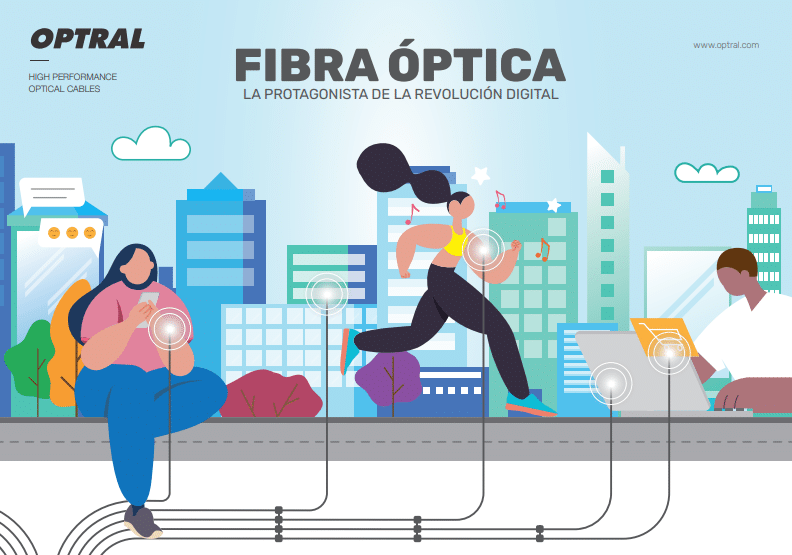
Smart cities represent the evolution of the traditional city concept thanks to the extensive use and application of information and communication technologies. Generally speaking, implementing a smart city is an operation based on deploying a stack of overlapping layers, each with a specific functionality and equipped with specialized sensors designed to collect large volumes of actionable data (big data).
OPTRAL is positioned as a solution provider for the base layer of the stack, which houses the smart infrastructure made up of fiber optic sensor cables operating with various photonic technologies (DTS, DAS, DSS, FBG). The ubiquity of fiber optics across all cities as a fundamental element of data transport networks also allows it to be leveraged for the direct and immediate deployment of sensing systems—or at least to reach the vicinity of the area to be monitored, from which it can be extended using OPTRAL fiber optic sensor cables.
In this regard, OPTRAL’s OSENSOR product line enables, among many other applications, improved energy efficiency, enhanced mobility and citizen safety, fire detection and prevention, structural health monitoring for roads, bridges, railways, and infrastructure, as well as a reduction in pollution and generated waste.
The competitive advantages of using fiber optics as a sensing element in a smart city environment are numerous:
- It is entirely immune to electromagnetic interference, making it free from radio frequency noise.
- It functions as thousands of virtual sensors and is completely passive.
- Sensors are distributed along the entire length of the cable and spaced just a few meters apart, allowing sensor density to increase exponentially.
- Operational costs (OPEX) are extremely low because they consume no electricity, require no replacement parts or recalibrations, and suffer virtually no breakdowns.
For more information about Optral Solutions products, you can send an email to amartinez@optral.es or contact us through the web form here.