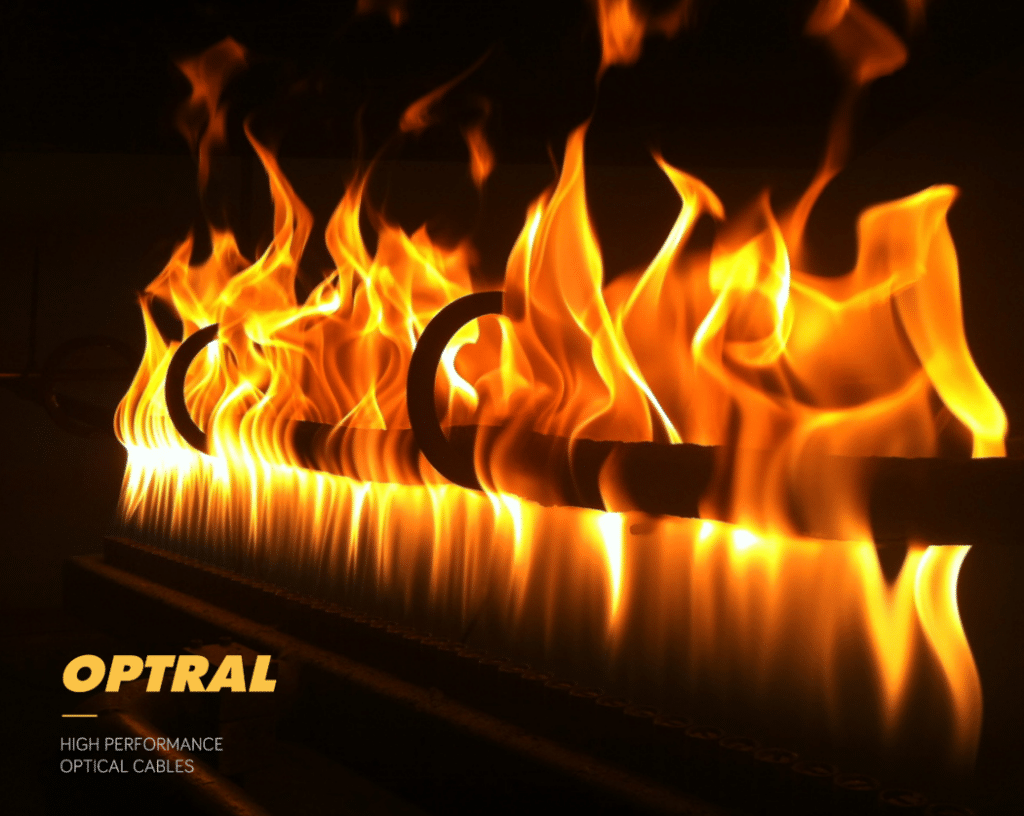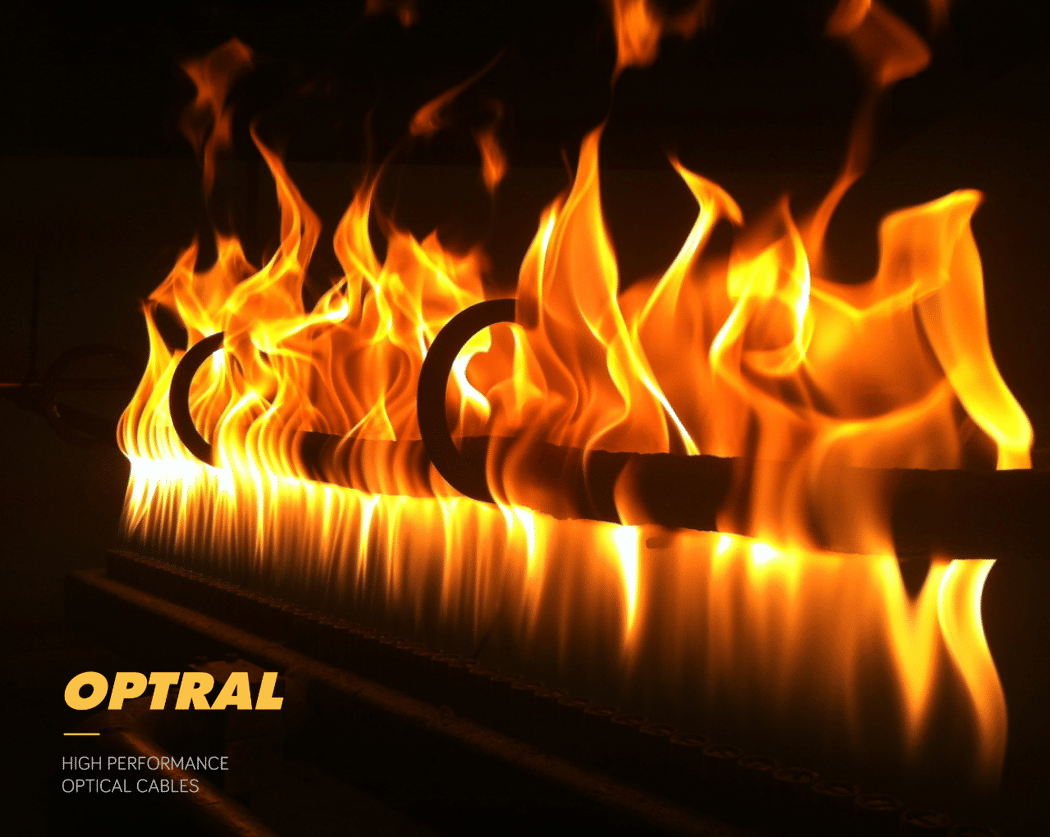
With the implementation of CPR regulations, the European Union aims to standardize and classify cables according to their reaction to fire. While some cables are designed to minimize flame spread and its associated risks, other applications—particularly safety and emergency circuits—demand that communications remain functional even when the cable is exposed to fire under specified conditions. In the field of fiber optics, there are two standard tests used to evaluate this property:
- IEC 60331-25:1999: Circuit integrity test for cables under fire conditions. The cable is subjected to a flame of at least 750°C for a minimum of 90 minutes. After this duration, the flame is turned off, but optical fiber monitoring continues for an additional 15 minutes. The test result is considered compliant if the attenuation increase in the fibers during the total 105 minutes does not exceed the maximum limit specified by the manufacturer.
- UNE-EN 50200:2007: Fire resistance test for small-diameter unprotected cables used in emergency circuits. The cable is subjected to an 830°C flame for a duration ranging from 30 minutes (PH30) up to 120 minutes (PH120). Every 5 minutes, a mechanical hammer strikes the cable support frame, dislodging charred particles. The test is considered compliant if the attenuation variation in each fiber does not exceed 1.0 dB for single-mode fiber and 2.0 dB for multimode fiber.
In its resistencia al fuego & CPR section, OPTRAL provides a comprehensive list of cables that pass these tests, highlighted by metallic armored cables such as QFCI and SWA (FR-750). We also offer 100% dielectric cables, including TENAX (FR-750) and DTDT (FR-750).